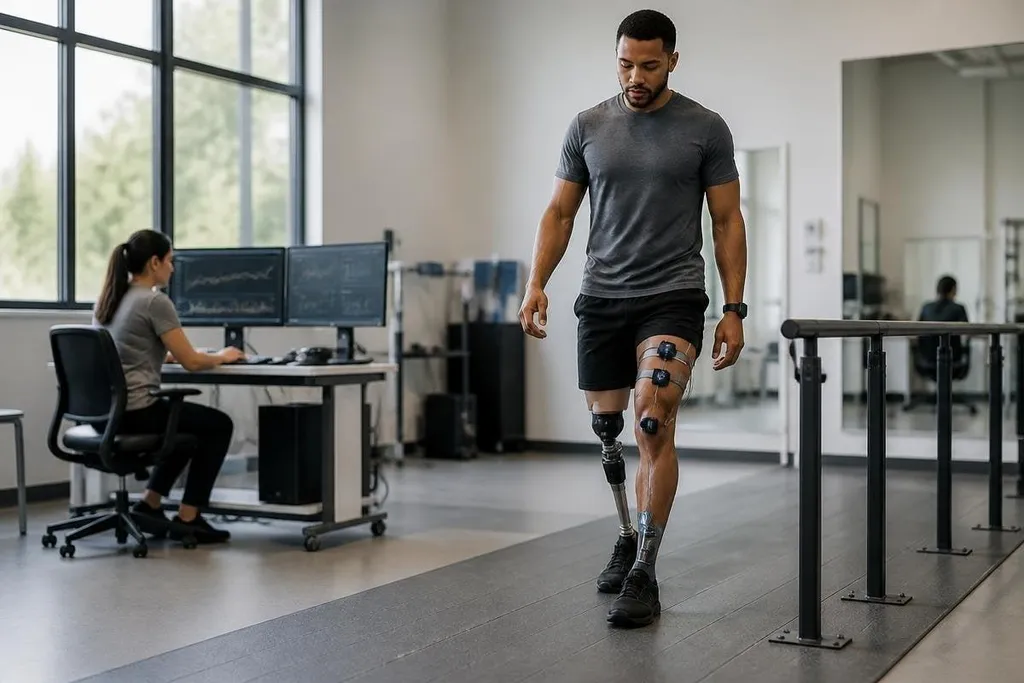
Robotic prosthetics can read muscle signals, joint motion, and pressure under the foot. AI helps turn those signals into movement, but a useful limb still has to react safely when the wearer changes speed, ground, or balance.
- Signals become commands: EMG sensors can read electrical activity from muscles near an amputation site.
- Movement can adjust: Software can change the motor response as walking conditions shift.
- Trust remains the test: A lab result does not show how a prosthesis behaves during a full day of use.
How AI reads the wearer
A robotic prosthesis starts with sensors. Surface electromyography, or EMG, measures small electrical signals from muscles through sensors placed on the skin. Those signals can indicate an intended action, such as bending the knee or lifting the foot.
The signal is noisy, though. Sensors can move against the skin, sweat can affect contact, and muscle signals vary as the wearer gets tired. An AI model can sort these changing patterns and estimate what movement the wearer wants.
That estimate then enters a control loop. The loop compares the intended motion with data from the prosthesis, such as joint angle, motor speed, and force. It sends a new motor command, checks the result, and repeats the process many times each second.
What changes during walking
Older control systems often rely on set rules for specific parts of a step. A robotic knee might use one response during stance, when the foot carries weight, and another during swing, when the leg moves forward.
AI can help the system choose between those responses from live sensor data. It may spot a slope after level ground, or detect that the wearer is stopping instead of taking another step. The practical gain is less manual switching during movement.
That does not mean the limb understands the wearer in a human sense. It estimates intent from patterns. A wrong estimate can send the leg into the wrong phase of a step, so the control system still needs limits that restrict unsafe motion.
A flat-floor walk tests only one part of a robotic prosthetic’s job. For someone deciding whether AI control works beyond a clinic, Robot24.com prosthetics reporting can tie the claim to the limb, test setting, date, and measured result. Those details show what the system can handle before stairs, uneven ground, and long wear raise harder questions.
The gap between a demo and daily use
A controlled test can show that an AI model identifies a small set of movements. Daily use brings more variation: the socket may shift, the surface may change, and the wearer may carry a bag or turn without warning.
Training data also shapes the result. If a model sees limited walking patterns, it may respond poorly to movements outside that set. A system that works for one wearer may need new setup work for another because residual muscles, socket fit, and walking style differ.
Battery use adds another limit. More sensors and more computing can raise power needs, while a heavier prosthesis can make walking harder. Any claim about better control needs to state which signals were used, how long the test ran, and what movements the wearer completed.
The strongest opposing view is that fixed rules may be easier to check and repair. That matters in a medical device, where a predictable response can be safer than a model that changes its output without a clear reason.
AI earns its place only when it handles more useful cases without making failures harder to spot.
A practical check before trusting the claim
Use this list when you read about an AI-controlled prosthesis:
- Name the input: Check whether the system reads EMG, joint motion, foot pressure, or another signal.
- Check the task: Find out if the test covered level walking only or included stairs, slopes, turns, and stops.
- Ask who tested it: A result from one wearer cannot describe every residual limb or socket fit.
- Find the failure rule: Look for limits that stop unsafe speed, force, or joint movement.
- Check the test length: A short session says little about sweat, fatigue, sensor shift, or battery use across a full day.
What needs to happen next
AI can make a robotic prosthesis respond to more than one fixed walking pattern. The open issue is proof outside the lab: longer trials, more wearers, varied surfaces, clear failure reports, and a control system that lets clinicians understand each decision.
I'd wait for that evidence before treating a clever movement demo as a finished medical product. The next useful result will be a prosthesis that keeps working after hours of walking, not one that completes a single clean step.